
Douglasville City Directory Holdings
The historical shelf is a group of related sources, not a continuous city directory run. FamilySearch verifies the catalog title “Douglasville (Douglas County, Ga.) city directory,” yet its public catalog view did not expose a publisher or year. The best next step is a catalog search followed by a direct call to Special Collections. Other dated collections can then test names, places, and gaps.
| Collection | Verified span | Where held | Access |
|---|---|---|---|
| Douglasville city directory title | Title confirmed; years unknown | FamilySearch catalog; ask locally | Catalog, account, or library |
| Genealogy books | More than 320 donated volumes | Selman and Dog River Special Collections | View-only |
| Douglas County Sentinel | 1917 through 1922 | Georgia Historic Newspapers | Free full-text search |
| Douglasville Sanborn maps | 1895, 1900, 1905, 1911, 1923 | Library of Congress and DLG | Free images |
| Federal census schedules | 1880 and 1900 through 1950 | NARA and library databases | Online or library |
| Georgia vital indexes | Death, marriage, and divorce spans vary | Georgia Archives and FamilySearch | Index, account, or reading room |
Coverage dates are evidence boundaries. Do not turn a catalog title into a made-up annual run. A librarian can confirm call numbers, formats, condition, and whether an item must remain in the reading room.
Douglasville City Directory Library Desk
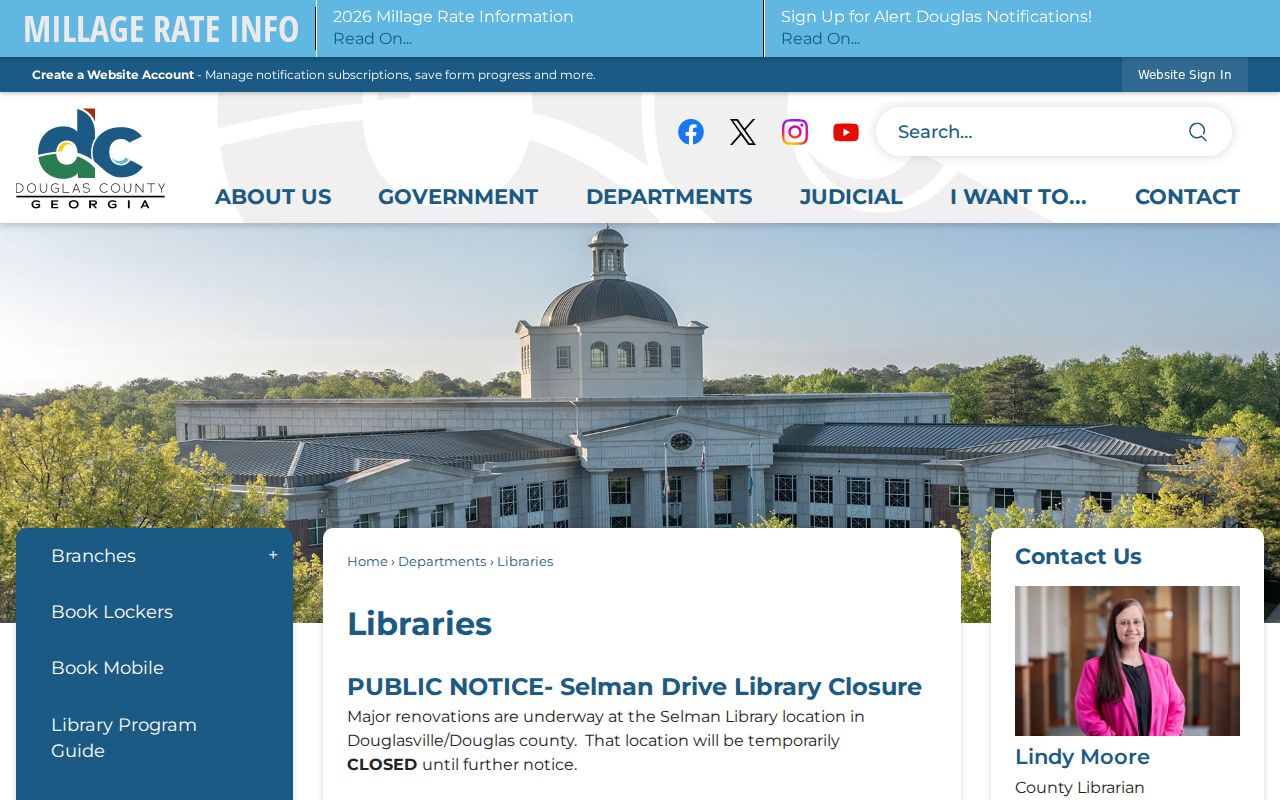
West Georgia Regional Library System provides catalog access, reference help, electronic resources, newspapers, and interlibrary loan. During renovation of the Selman Drive building, the temporary Douglasville branch is at 8465 Campbellton Street. Its published hours are Monday through Thursday, 9 a.m. to 7 p.m., and Friday through Saturday, 10 a.m. to 4 p.m. The phone is 470-353-7807.
Douglas County Genealogical Society reports that more than 320 donated genealogy volumes are housed as noncirculating Special Collections at the Douglas County or Selman and Dog River branches. Library computers offer Ancestry and HeritageQuest access, subject to staff authentication. A virtual reference request promises a reply within two business days. Georgia residents, and people who work or attend school in Georgia, may receive free cards; the stated annual nonresident fee is $25.
The library system's official pages are the source for current access.

Read a Douglasville Directory Entry
No authoritative local sample entry was accessible in the inspected catalog, so the field list below describes what the collection providers say an entry may contain. Printed city directories use dense abbreviations to save space. Read the key at the front of the same volume before expanding a title, occupation, street, or household mark.
| Printed field | What to record |
|---|---|
| Name and title | Exact spelling, initials, honorific, and suffix |
| Spouse or marital note | Printed spouse name or status, without adding an inference |
| Occupation or business | Occupation text, employer, or business ownership as printed |
| Home address | Number, street name, directional, and unit |
| Householder mark | Owner or renter symbol only if the volume key defines it |
- Abbreviation key
- The volume's own legend for compressed words and symbols.
- Householder index
- A section grouping entries by household or address form.
- Criss-cross directory
- An address-first arrangement used to look from street number to listed name.
- Imprint year
- The year printed on the volume, which may follow the canvass date.
A listing is a dated claim from that publisher. A person may have moved after the canvass, declined a listing, or appeared under initials. Save an image or full citation rather than copying only the name.
Douglasville Directory Names in Print
The Georgia Historic Newspapers portal provides a full-text run of the Douglas County Sentinel from January 5, 1917, through December 29, 1922. Search an exact surname, then variants, initials, a street, or a business. Obituaries, legal notices, social columns, and advertisements can explain why a directory entry changed.
Optical character recognition often misreads worn type. Browse nearby issues when a known name fails. An advertisement may place a business downtown, while a social notice may distinguish two people with the same initials. Neither should override a deed, certificate, or census schedule when the facts conflict.
The Genealogical Society newsletter, The Skint Chestnut Logs, adds local family articles and research methods. Ask Special Collections about its issue holdings rather than assuming every number is online.
Map Douglasville Directory Addresses
Five dated Sanborn editions provide the strongest verified address companion: July 1895, March 1900, November 1905, July 1911, and June 1923. The sheets show footprints, construction materials, uses, outbuildings, street labels, and physical change. They do not identify everyone inside a building.
Use the Douglasville Sanborn map collection after finding a printed address. Compare the sheet index, street orientation, and lot position. Then connect the structure to a tax digest, deed, census household, or confirmed directory entry. Old labels may not match current numbers, especially along Bankhead Highway and U.S. 78.
Maps can keep a city directory search on the right building when street names shift. They cannot fill an occupant gap by themselves.
Douglasville Directory Coverage Gaps
The statewide digitized project contains 214 city directories for 17 Georgia communities across nearly a century. Its named communities include Acworth, Austell, Mableton, Marietta, and Smyrna, but not Douglasville. Nearby coverage offers regional context. It is not proof that a Douglasville volume is digitized there.
FamilySearch's broad United States directory collection spans roughly 1749 to 1990 and may return a name, occupation, and address. Catalog access can vary by item: an open image, signed-in account, affiliate library, microfilm, or physical copy. Search by place, title, keyword, author, subject, surname, call number, film or image-group number, and availability.
Trace Douglasville Families by Directory
A year-by-year comparison can show a household's first listing, a move, an occupation change, or a disappearance. It works best when paired with census schedules and recorded land evidence. The directory canvass may precede the imprint year, so a one-year mismatch is not automatically a contradiction.
- Find the surname alphabetically in year T. Copy spelling, initials, spouse, occupation, employer, address, and abbreviations.
- Check T minus one and T plus one. A neighboring year may reveal a move or show that one volume omitted the person.
- Use an address or criss-cross section only if the confirmed volume has one. Record neighbors as printed, not as assumed family.
- Compare the closest public census schedule. The 1890 federal census is largely destroyed, while 1950 is the newest public schedule under the 72-year rule.
- Close the trail with a deed, newspaper item, obituary, probate file, or vital index that independently matches the person.
Disappearance can mean death, relocation, omission, a spelling change, or a decision not to list. It takes another source to choose among those explanations.
Before Douglasville City Directories
Douglas County was created in 1870 from parts of Cobb, Campbell, and Carroll counties. Clerk custody starts in 1871. For an event or parcel before 1870, identify which parent county held the land at that date and search that county's deed, tax, probate, and court records. A later Douglasville label should not be projected backward.
The city was established in 1875 after the earlier Skint Chestnut settlement became county seat. Atlanta rail service began in 1882, followed by the Birmingham connection in 1883. Early business and directory research should focus on the courthouse and rail downtown, while later evidence spreads toward I-20, State Routes 5 and 92, Arbor Place, and Chapel Hill.
This geography explains why a historical city directory and a modern address search can point to different commercial corridors.
Douglasville Records Changed Buildings
The courthouse story explains where older local material may be found. A large brick clock-tower courthouse was completed in 1896. It burned on January 11, 1956. A replacement followed in 1956 and 1957, and the current government complex opened in February 1998. The former courthouse now houses museum and Historical Society space.
| Date | Douglasville record-place event |
|---|---|
| 1871 | Douglas County clerk custody begins |
| 1896 | Clock-tower courthouse completed |
| 1956 | Documented courthouse fire |
| 1956-57 | Replacement courthouse completed |
| 1998 | Current government complex opens |
Sources conflict on record-loss dates. Georgia Archives flags 1896 and 1969, another manual lists 1896 and 1957, and DLG documents the 1956 fire. Do not claim which volumes were destroyed until the Douglas County Cards are checked.
The county library page confirms genealogy and local-history service.
Verify a Douglasville Directory Find
A city directory entry is most useful when its printed details match a second independent record. Pair the address with a census household, deed, tax record, newspaper notice, or vital index from the same period. Keep source dates visible. A modern parcel record cannot prove who occupied the address decades earlier.
The Douglas County Museum of History and Art is another inquiry point for telephone books, photographs, vertical files, yearbooks, and newspapers; the official county directory lists 678-449-3939. Georgia Archives can help with state and county records. PINES interlibrary delivery reaches nearly 300 outlets, while GALILEO access conditions depend on the library.
If the goal shifts to current address-keyed ownership, use the Douglasville street directory workflow. Historical city directories remain the right shelf for reading names, occupations, spouses, and addresses as one publisher recorded them at one point in time.